i.) f(a) is defined ,
ii.)  exists (i.e., is finite) ,
and exists (i.e., is finite) ,
iii.) 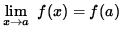 .
.
Function f is said to be continuous on an interval I if f is continuous at each point x in I. Here is a list of some well-known facts related to continuity : .- 1. The SUM of continuous functions is continuous.
2. The DIFFERENCE of continuous functions is continuous.
3. The PRODUCT of continuous functions is continuous.
4. The QUOTIENT of continuous functions is continuous at all points x where the DENOMINATOR IS NOT ZERO.
5. The FUNCTIONAL COMPOSITION of continuous functions is continuous at all points x where the composition is properly defined.
6. Any polynomial is continuous for all values of x.
7. Function ex and trigonometry functions
 and
and  are continuous for all values of x.
A few practice questions for your brief understanding:
Most problems that follow are average. A few are somewhat challenging. All limits are determined WITHOUT the use of L'Hopital's Rule. If you are going to try these problems before looking at the solutions, you can avoid common mistakes by using the above step-by-step definition of continuity at a point and the well-known facts, and by giving careful consideration to the indeterminate form  during the computation of limits. Knowledge of one-sided limits will be required. For a review of limits and indeterminate forms click here.
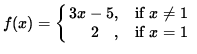
during the computation of limits. Knowledge of one-sided limits will be required. For a review of limits and indeterminate forms click here.- PROBLEM 1 : Determine if the following function is continuous at x=1 .
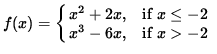
- PROBLEM 2 : Determine if the following function is continuous at x=-2 .
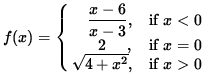
- PROBLEM 3 : Determine if the following function is continuous at x=0 .
- PROBLEM 4 : Determine if the function
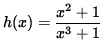 is continuous at x=-1 .
- PROBLEM 5 : Check the following function for continuity at x=3 and x=-3 .
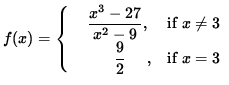
- PROBLEM 6 : For what values of x is the function
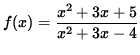 continuous ?
- PROBLEM 7 : For what values of x is the function
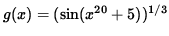 continuous ?
- PROBLEM 8 : For what values of x is the function
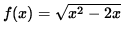 continuous ?
- PROBLEM 9 : For what values of x is the function
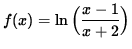 continuous ?
- PROBLEM 10 : For what values of x is the function
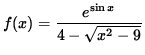 continuous ?
- PROBLEM 11 : For what values of x is the following function continuous ?
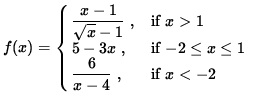
- PROBLEM 12 : Determine all values of the constant A so that the following function is continuous for all values of x .
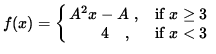
- PROBLEM 13 : Determine all values of the constants A and B so that the following function is continuous for all values of x .
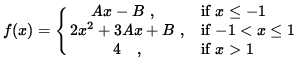
- PROBLEM 14 : Show that the following function is continuous for all values of x .
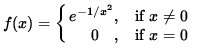
- PROBLEM 15 : LetShow that f is continuous for all values of x . Show that f is differentiable for all values of x, but that the derivative, f' , is NOT CONTINUOUS at x=0 .
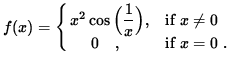
Solutions of above given problems:
SOLUTION 1 : Function f is defined at x=1 since
i.) f(1) = 2 .The limit
 = 3 (1) - 5= -2 ,i.e.,
ii.)But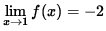 .
.
iii.)so condition iii.) is not satisfied and function f is NOT continuous at x=1 .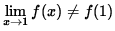 ,
,
SOLUTION 2 : Function f is defined at x=-2 since
i.) f(-2) = (-2)2 + 2(-2) = 4-4 = 0 .The left-hand limit
 = (-2)2 + 2(-2)= 4 - 4= 0 .The right-hand limit
 = (-2)3 - 6(-2)= -8 + 12= 4 .Since the left- and right-hand limits are not equal, ,
ii.)and condition ii.) is not satisfied. Thus, function f is NOT continuous at x=-2 . does not exist,
SOLUTION 3 : Function f is defined at x=0 since
i.) f(0) = 2 .The left-hand limit
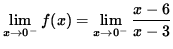
 = 2 .The right-hand limit
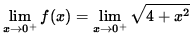

 = 2 .Thus,
 exists with
ii.)Since .
.
iii.)all three conditions are satisfied, and f is continuous at x=0 .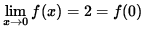 ,
,
SOLUTION 4 : Function h is not defined at x=-1 since it leads to division by zero. Thus,
i.) h(-1)does not exist, condition i.) is violated, and function h is NOT continuous at x = -1
SOLUTION 5 : First, check for continuity at x=3 . Function f is defined at x=3 since
i.)The limit .
.
(Circumvent this indeterminate form by factoring the numerator and the denominator.)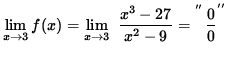
(Recall that A2 - B2 = (A-B)(A+B) and A3 - B3 = (A-B)(A2+AB+B2 ) . )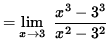
(Divide out a factor of (x-3) . )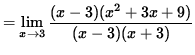
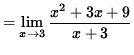 =
=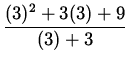
 i.e.,
i.e., ,
,
ii.)Since, .
.
iii.)all three conditions are satisfied, and f is continuous at x=3 . Now, check for continuity at x=-3 . Function f is not defined at x = -3 because of division by zero. Thus,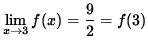 ,
,
i.) f(-3)does not exist, condition i.) is violated, and f is NOT continuous at x=-3 .
SOLUTION 6 : Functions y = x2 + 3x + 5 and y = x2 + 3x - 4 are continuous for all values of x since both are polynomials. Thus, the quotient of these two functions,
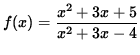 , is continuous for all values ofx where the denominator, y = x2 + 3x - 4 = (x-1)(x+4) , does NOT equal zero. Since (x-1)(x+4) = 0 for x=1 and x=-4 , function f is continuous for all values of x EXCEPT x=1 and x=-4 .
SOLUTION 7 : First describe function g using functional composition. Let f(x) = x1/3 ,
 , and k(x) = x20 + 5 . Function k is continuous for all values of x since it is a polynomial, and functions f and h are well-known to be continuous for all values of x . Thus, the functional compositions
and
are continuous for all values of x . Since
function g is continuous for all values of x . ,
,
SOLUTION 8 : First describe function f using functional composition. Let g(x) = x2 - 2x and
 . Function g is continuous for all values of x since it is a polynomial, and function h is well-known to be continuous for
  . Since g(x) = x2 - 2x = x(x-2) , it follows easily that
  for
for  and
and  . Thus, the functional composition
is continuous for and . Since
function f is continuous for , and .
SOLUTION 9 : First describe function f using functional composition. Let
 and
and  . Since g is the quotient of polynomials y = x-1 and y = x+2 , function g is continuous for all values of xEXCEPT where x+2 = 0 , i.e., EXCEPT for x = -2 . Function h is well-known to be continuous for x > 0 . Since , it follows easily that g(x) > 0 for x < -2 and x > 1 . Thus, the functional composition
is continuous for x < -2 and x > 1 . Since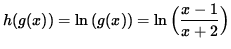
function f is continuous for x < -2 and x > 1 .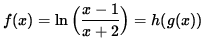 ,
,
SOLUTION 10 : First describe function f using functional composition. Let
 and h(x) = e x , both of which are well-known to be continuous for all values of x . Thus, the numerator
 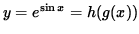 is continuous (the functional composition of continuous functions) for all values of x . Now consider the denominator
 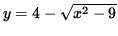 . Let g(x) = 4 , h(x) = x2 - 9 , and
  . Functions g and h are continuous for all values of x since both are polynomials, and it is well-known that function k is continuous for . Since h(x) = x2 - 9 = (x-3)(x+3) = 0 when x=3 or x=-3 , it follows easily that
  for
for  and
and  , so that
 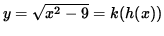 is continuous (the functional composition of continuous functions) for and . Thus, the denominator is continuous (the difference of continuous functions) for and . There is one other important consideration. We must insure that the DENOMINATOR IS NEVER ZERO. If
then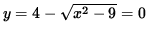
Squaring both sides, we get .
.
16 = x2 - 9so that
x2 = 25when
x = 5 or x = -5 .Thus, the denominator is zero if x = 5 or x = -5 . Summarizing, the quotient of these continuous functions,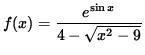 , is continuous for and , but NOT for x = 5 and x = -5 .
SOLUTION 11 : Consider separately the three component functions which determine f . Function
 is continuous for x > 1 since it is the quotient of continuous functions and the denominator is never zero. Function y = 5 -3x is continuous for
  since it is a polynomial. Function
  is continuous for x < -2 since it is the quotient of continuous functions and the denominator is never zero. Now check for continuity of f where the three components are joined together, i.e., check for continuity at x=1 and x=-2 . For x = 1 function f is defined since
i.) f(1) = 5 - 3(1) = 2 .The right-hand limit
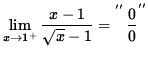
(Circumvent this indeterminate form one of two ways. Either factor the numerator as the difference of squares, or multiply by the conjugate of the denominator over itself.) =
= 
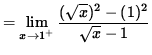
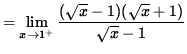
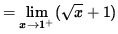
 = 2 .The left-hand limit
 =
=  = 5 - 3(1)= 2 .Thus,
ii.)Since .
.
iii.)all three conditions are satisfied, and function f is continuous at x=1 . Now check for continuity at x=-2 . Function f is defined at x=-2 since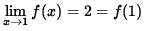 ,
,
i.) f(-2) = 5 - 3(-2) = 11 .The right-hand limit
 =
= 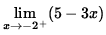 = 5 - 3( -2)= 11 .The left-hand limit
 =
= 

 = -1 .Since the left- and right-hand limits are different,
ii.)condition ii.) is violated, and function f is NOT continuous at x=-2 . Summarizing, function f is continuous for all values of x EXCEPT x=-2 . does NOT exist,
SOLUTION 12 : First, consider separately the two components which determine function f . Function y = A2 x - A is continuous for
for any value of A since it is a polynomial. Function y = 4 is continuous for x < 3 since it is a polynomial. Now determine A so that function f is continuous at x=3 . Function f must be defined at x=3 , so
i.) f(3)= A2 (3) - A = 3 A2 - A .The right-hand limit
 =
= 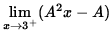 = A2 (3) - A= 3 A2 - A .The left-hand limit
 =
=  = 4 .For the limit to exist, the right- and left-hand limits must exist and be equal. Thus,
ii.)so that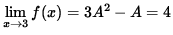 ,
,
3 A2 - A - 4 = 0 .Factoring, we get
(3A - 4)(A + 1) = 0for
For either choice of A , or A = -1 .
iii.)all three conditions are satisfied, and f is continuous at x=3 . Therefore, function f is continuous for all values of x if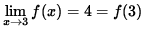 , or A = -1 .
SOLUTION 13 : First, consider separately the three components which determine function f . Function y = Ax - B is continuous for
 for any values of A and B since it is a polynomial. Function y = 2x2 + 3Ax + Bis continuous for
  for any values of A and B since it is a polynomial. Function y = 4 is continuous for x > 1 since it is a polynomial. Now determine A and B so that function f is continuous at x=-1 and x=1 . First, consider continuity at x=-1 . Function f must be defined at x=-1 , so
i.) f(-1)= A(-1) - B = - A - B .The left-hand limit
 =
= 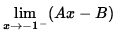 = A (-1) - B= - A - B .The right-hand limit
 =
= 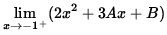 = 2(-1)2 + 3A(-1) + B= 2 - 3A + B .For the limit to exist, the right- and left-hand limits must exist and be equal. Thus,
ii.)so that ,
,
2A - 2B = 2 ,or
(Equation 1)
A - B = 1 .Now consider continuity at x=1 . Function f must be defined at x=1 , so
i.) f(1)= 2(1)2 + 3A(1) + B = 2 + 3A + B .The left-hand limit
= 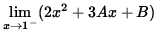 = 2(1)2 + 3A(1) + B= 2 + 3A + B .The right-hand limit
=  = 4 .For the limit to exist, the right- and left-hand limits must exist and be equal. Thus,
ii.)or ,
,
(Equation 2)
3A + B = 2 .Now solve Equations 1 and 2 simultaneously. Thus,
A - B = 1 and 3A + B = 2are equivalent to
A = B + 1 and 3A + B = 2 .Use the first equation to substitute into the second, getting
3 (B + 1 ) + B = 2 ,3 B + 3 + B = 2 ,and
4 B = -1 .Thus,
and
For this choice of A and B it can easily be shown that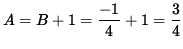 .
.
iii.)and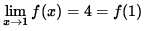
iii.)so that all three conditions are satisfied at both x=1 and x=-1 , and function f is continuous at both x=1 and x=-1 . Therefore, function f is continuous for all values of x if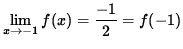 ,
, and .
and .
SOLUTION 14 : First describe f using functional composition. Let g(x) = -1/x2 and h(x) = ex . Function h is well-known to be continuous for all values of x . Function g is the quotient of functions continuous for all values of x , and is therefore continuous for all values of x except x=0 , that x which makes the denominator zero. Thus, for all values of x except x=0 ,
f(x) = h ( g(x) ) = e g(x) = e -1/x2is a continuous function (the functional composition of continuous functions). Now check for continuity of f at x=0 . Function f is defined at x=0 since
i.) f(0) = 0 .The limit
(The numerator approaches -1 and the denominator is a positive number approaching zero.)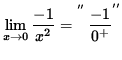
so that ,
,
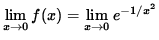


 = 0 ,i.e.,
ii.)Since .
.
iii.)all three conditions are satisfied, and f is continuous at x=0 . Thus, f is continuous for all values of x .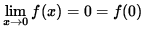 ,
,
SOLUTION 15 : First show that f is continuous for all values of x . Describe f using functional composition. Let ,
,  , and k(x) = x2 . Function h is well-known to be continuous for all values of x . Function k is a polynomial and is therefore continuous for all values of x . Function g is the quotient of functions continuous for all values of x , and is therefore continuous for all values of x except x=0 , that x which makes the denominator zero. Thus, for all values of x except x=0 ,
is a continuous function (the product and functional composition of continuous functions). Now check for continuity of f at x=0 . Function f is defined at x=0 since
i.) f(0) = 0 .The limit does not exist since the values of
  oscillate between -1 and +1 as x approaches zero. However, for
so that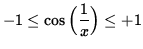
Since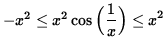 .
.
it follows from the Squeeze Principle that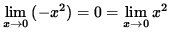 ,
,
ii.)Since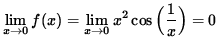 .
.
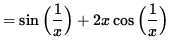
iii.)all three conditions are satisfied, and f is continuous at x=0 . Thus, f is continuous for all values of x . Now show that f is differentiable for all values of x . For , we can differentiate f using the product rule and the chain rule. That is, for the derivative of f is


 Use the limit definition of the derivative to differentiate f at x=0 . Then
 .
.
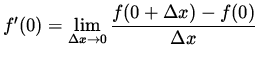
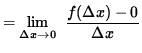
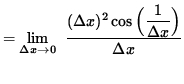 Use the Squeeze Principle to evaluate this limit. For
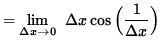 .
.
If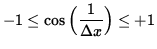 .
. , then
If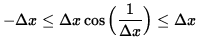 .
. , then
In either case,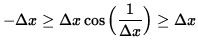 .
.
and it follows from the Squeeze Principle that ,
,
Thus, f is differentiable for all values of x . Check to see if f' is continuous at x=0 . The function f' is defined at x=0 since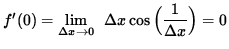 .
.
i.) f'(0) = 0 .However,
ii.)does not exist since the values of
 oscillate between -1 and +1 as x approaches zero. Thus, condition ii.) is violated, and the derivative , f' , is not continuous at x=0 .
NOTE : The continuity of function f for all values of x also follows from the fact that f is differentiable for all values of x .
Hope this helped to get rid of ambiguity in basic concepts of Continuity.
Kindly take some time to respond and let me know about your suggestions or any queries related to this topic.
Regards:
-Farhan Abbas

No comments:
Post a Comment